
Follow-up, in three questions.
Teeth whitening follow-up means reviewing how treatment progresses and what the patient reports, during treatment and at later check-ups defined by their dentist. Whiteness changes are one part of that review, not an automatic treatment decision.
- What should be recorded? Estimated progress, the product and modality, dates and patient-reported sensitivity. Missing records should remain visible as missing information.
- Who reviews the information? The treating clinic, through a review and communication workflow explained to the patient. An app is not continuous surveillance.
- What happens after treatment? The earlier history provides context to review possible losses of whiteness and assess check-ups or touch-ups. A chart alone does not confirm relapse.
Start with the workflow, not the chart
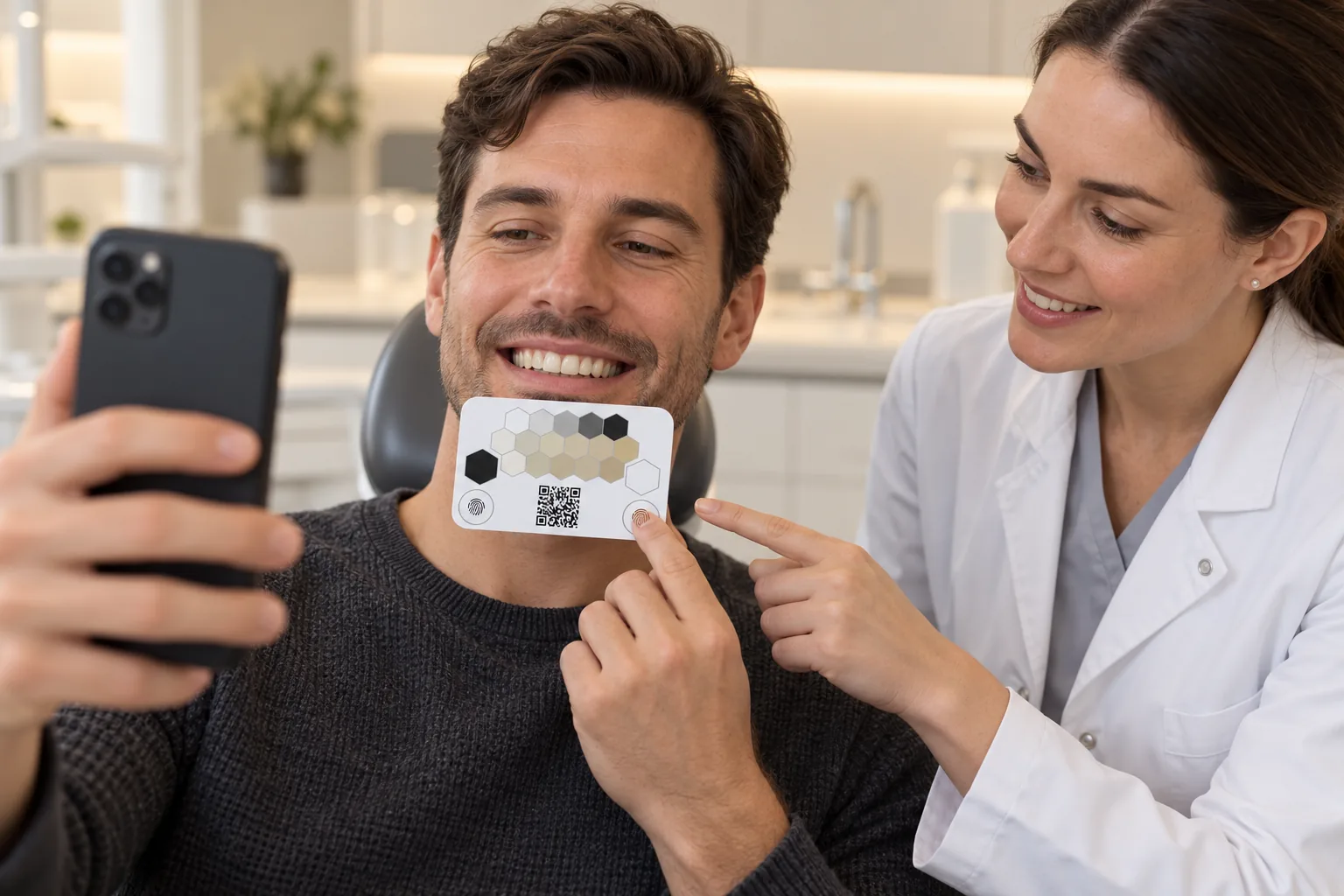
Teeth whitening follow-up becomes useful when it fits the way a dental clinic works. Before handing over a card, decide who explains it, who reviews the records and how a patient enquiry is handled. A remote channel must not create an expectation of continuous surveillance or replace appointments the dentist considers necessary. Chromic’s proposition connects a reference card, the patient app and a clinic portal to give that continuity a dedicated setting. It does not turn an estimated trajectory into an automatic treatment plan. This article describes an organisational approach, not a therapeutic protocol or a clinically validated service outcome. The initial assessment and choice of treatment remain the responsibility of the treating professional. Technology should support that relationship rather than make its responsibilities less clear.
Explain what is recorded, and what is not
A short explanation at the outset can prevent misunderstandings later. Patients need to know that the app follows estimated changes in whiteness over time; it does not identify the exact colour of their teeth or provide a dental health score. Explain the card’s role and why the capture instructions matter. eWID is a photographic estimate, not an instrumental WID measurement. A simple example chart can help make the distinction, provided it is clearly illustrative. A rising line is not an aesthetic guarantee, a falling observation is not a confirmed relapse and a stable segment is not an instruction to stop treatment. The aim is to help the patient record and communicate, not ask them to make clinical decisions from an isolated number on a phone.
Read each observation in context
A time series is easier to understand alongside the recorded product, modality, phase and elapsed time. Reported sensitivity supplies a different kind of context: it records what the patient says, not an automatic measurement of pain. When setting up follow-up, check that the patient history and card are correctly linked and do not confuse available information with fields that are not yet collected. A missing observation does not establish an absence of discomfort or prove that instructions were ignored. Asking what happened may be more useful than filling the gap with an assumption. Chromic must not invent intermediate observations to make a curve look continuous, or attribute a change to a product without considering other explanations. A useful review preserves uncertainty instead of concealing it behind a smoother picture.
Define the review and communication routine
The clinic portal is intended as the remote review setting for authorised follow-up of the clinic’s own patients. Its practical value also depends on an agreed working rule: review at a communicated frequency and use a clear channel when more information is needed. Explain which questions can be addressed remotely and which require an appointment or another form of contact. The American Dental Association describes sensitivity and irritation among possible effects of whitening, so listening to patients matters alongside reviewing their trajectory. An unanswered message is not supervision. Clinics should explain their response times without promising immediate attention. The commercial website is not a channel for clinical information, and patients should not send photographs or sensitive health details through the business enquiry form.
Keep treatment decisions with the professional
An upward trend does not by itself justify extending treatment. Equally, a plateau does not automatically determine when it should end. Assessment includes the clinical situation, product instructions, patient reports and the quality of the available information. An app should not recommend additional days because a line keeps rising, or suggest that a regimen is safe simply because no sensitivity was recorded. The estimate provides one piece of context for the dentist, rather than a replacement for professional judgement. If an important capture or follow-up condition changes, compatibility also needs review before differences are interpreted. A digital workflow does not remove the need to document clinical decisions or communicate a revised plan directly to the patient. More observations are not automatically better evidence if the conditions behind them have changed.
Plan for what happens afterwards
Completing a treatment phase can open another conversation: which later checks are appropriate, how the history is reviewed and what to do if the patient notices changes. Maintaining continuity does not mean automatically diagnosing relapse. Keep phases and conditions for comparison clear before incorporating later observations. Access must remain clear too: the treating clinic’s ability to recognise its own patient does not pass to a network or manufacturer through a card purchase or a logo. Interface examples on this website contain fictional data, not real patient histories. To assess Chromic for your clinic, consider the complete workflow: explanation, guided capture, professional review and communication. Cards are not on sale yet. You can explore the packs and request an availability notification without making a payment, placing a reservation or subscribing to a newsletter.
Sources and scope
General background resources; not validation studies of Chromic or product endorsements.