
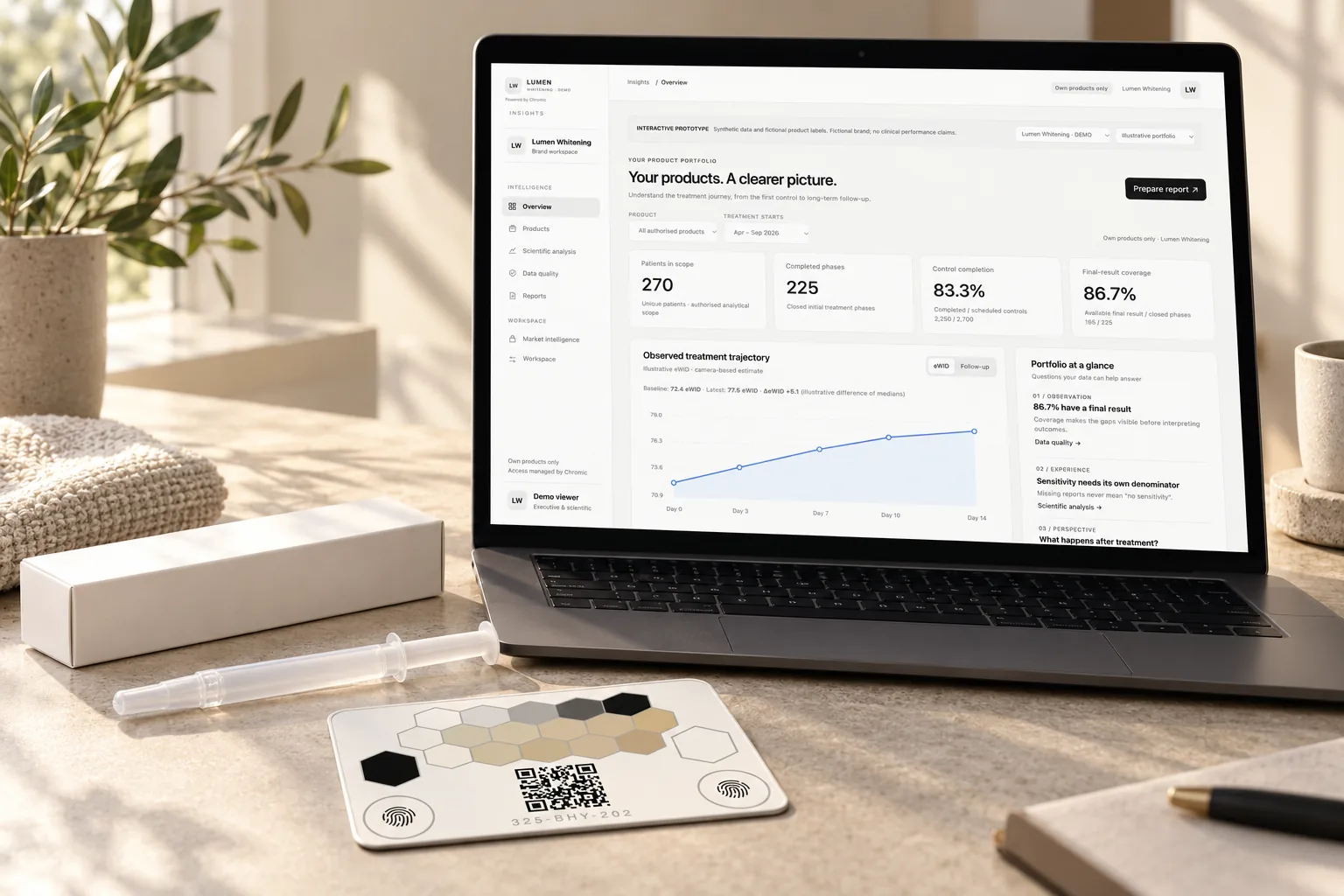
From distribution to follow-up questions
A brand knows its product references, distribution and use instructions. That does not mean it knows what happens in each follow-up after the product leaves the factory. There are questions beyond units sold: which modalities are recorded, how long histories are observed and when sensitivity is reported. Chromic Insights is intended to explore aggregated information about a brand’s own products and the associated follow-up. The screens on this website are currently prototypes with fictional data, not an accessible patient database or an enabled production analytics service. This article explains the proposition and its precautions. It does not report efficacy findings, market shares or conclusions about specific manufacturers’ products. A useful starting point is to identify what information would genuinely answer a question, rather than assume a dashboard already contains it.
What context helps explain a series?
An isolated result says little without its context. An aggregated view needs to distinguish the declared product, modality, elapsed time and observation coverage. It also matters which fields are actually available, which are missing and how they were recorded. Age bands or other variables should only be included with an authorised purpose and adequate group protection. An unknown composition must not be filled in, and a sold product must not be assumed to have been fully used. Distribution, prescribed treatment, declared use and actual exposure are not interchangeable concepts. Information from a follow-up workflow is what that workflow collects, within its limits; it is not an automatic reconstruction of everything happening at home or in a clinic. More detailed presentation cannot recover facts that were never recorded in the first place.
Reported sensitivity does not establish causation
Understanding when sensitivity is reported can help frame questions for product review or professional information. It does not, by itself, establish that a product caused a symptom or allow brands to be ranked by safety. Consider how questions are asked, when patients respond, which observations are missing and what conditions accompany follow-up. The absence of a report does not demonstrate the absence of discomfort. A responsible panel distinguishes declared information from inference and does not turn an association into a causal conclusion. Studying safety or efficacy requires appropriate objectives, methodology and evaluation beyond a commercial visualisation. Insights should not become a route to clinical claims based on an appealing correlation. Descriptive information can suggest a question worth investigating while leaving its answer genuinely unresolved.
Estimated trajectories need comparison conditions
eWID is a photographic whiteness estimate, not instrumental WID measurement or exact tooth colour identification. Its central purpose is longitudinal follow-up within compatible histories. Aggregating observations does not automatically validate comparisons between patients, devices, regimens or products. A group with a larger mean change may have a different composition, duration or observation coverage. Before discussing performance, establish what is being compared and what uncertainty remains. Descriptive questions can guide later investigation but cannot resolve it on their own. Learning more about follow-up after sale is not a promise to identify the best whitening product, predict an individual’s result or recommend how many days treatment should continue. Clinical interpretation and decisions remain with the professional responsible for the patient, not with a manufacturer’s aggregated chart.
Aggregated information, without access to identities
Insights separates secondary analytics from individual clinical care. A brand must not receive names, emails, photographs, messages or individual histories simply because it manufactures a product or funds cards. The GDPR distinguishes anonymous information from personal data: removing a name is not enough to establish that identification risk has disappeared. Small groups, combinations of filters and other ways to infer information about a person need assessment too. The proposition requires permissions, authorisation for the secondary purpose and cohort protection before real data are enabled. A prototype does not establish those safeguards in production. The clinic retains its clinical relationship and its own access scope; that capability is not inherited by a brand dashboard. Commercial value must be designed around that boundary rather than treating it as an obstacle to remove.
Define the question worth answering first
The best initial discussion is not about how many charts a platform can display, but which legitimate decision it should inform and what evidence would be needed. Understanding follow-up coverage for an owned product is different from demonstrating a clinical advantage over another product. Agree who will read a report, which groups will not be shown and how missing information will be explained. App or physical card branding can provide visual continuity to a programme, but its commercial terms are separate from data access. Chromic Insights is in development and access is agreed independently. If you represent a whitening brand, we can review fit and useful questions without promising available data, validated comparisons or access to individual patients. A clear boundary between commercial presentation and scientific evidence is part of the proposition, not an afterthought.
Sources and scope
General background resources; not validation studies of Chromic or product endorsements.